What happens to a new car’s paint before the PPF goes on?
The paint has to be clean, free of anything that would stop the film sticking, decontaminated, measured and inspected, and only then polished if it needs it. Film is the last step, on a surface that’s as clean as it will ever be.
| Step | What happens | Why it matters under film |
|---|---|---|
| 1. Wash | Loose dirt and road film off every panel | Grit left on the paint ends up under the film |
| 2. Strip | Wax, sealant or a dealer coating removed | These can stop the film’s adhesive bonding to the paint |
| 3. Decontaminate | Bonded particles lifted from the clear coat | A particle sealed under film shows as a bump |
| 4. Measure | Paint thickness read before any polishing | Tells the shop how much clear coat there is to work with |
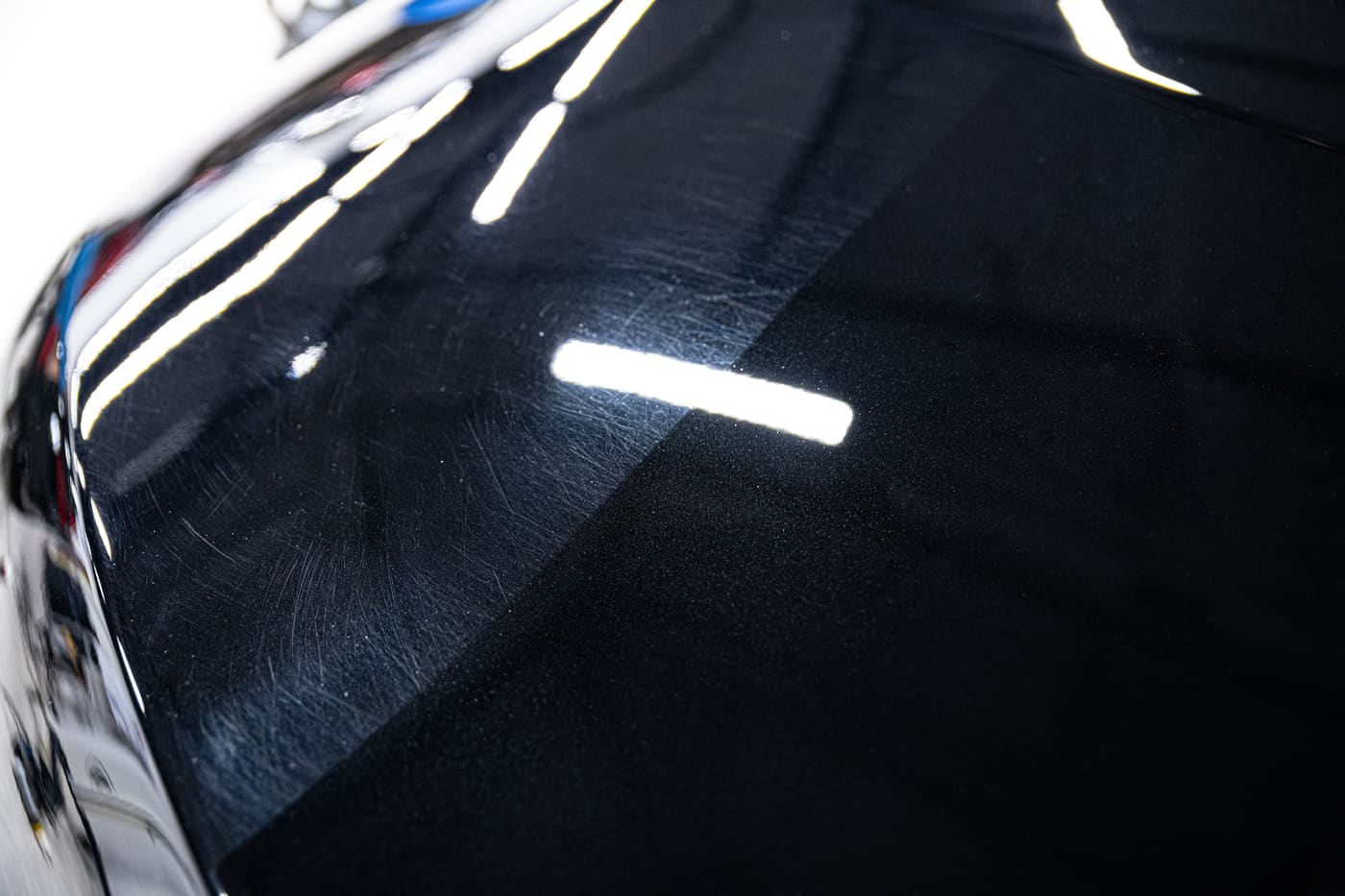
| 5. Inspect | Panels checked under inspection lighting | Shows swirls and haze a showroom light hides |
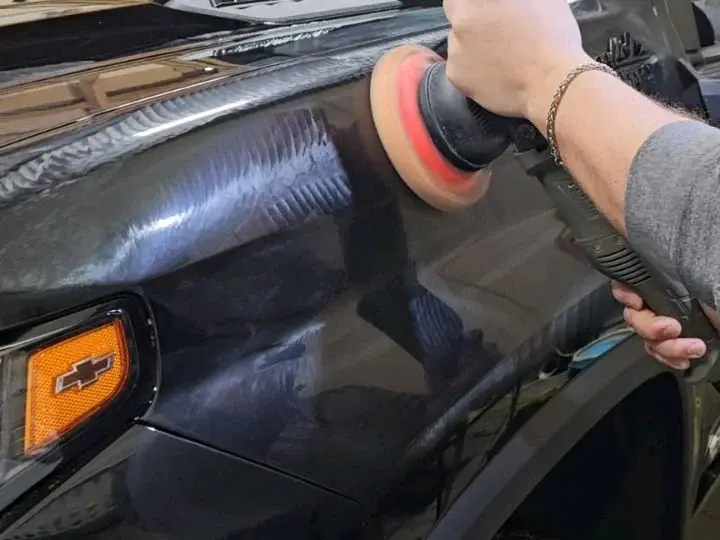
| 6. Correct, if needed | Enhancement polish or two-stage correction | Film locks in whatever is left |
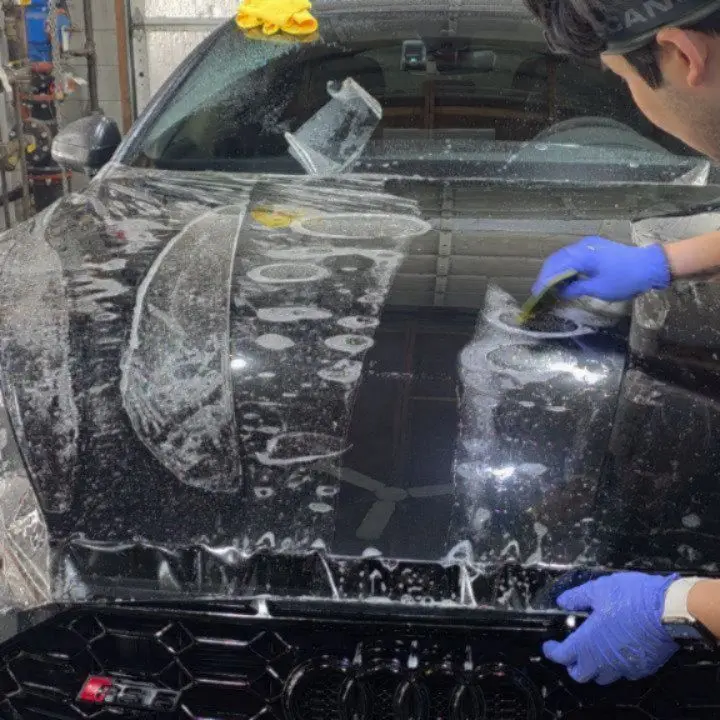
| 7. Film | LLumar Platinum, cut by software to the car | Applied to the prepared panels |
The film makers set out the same order. 3M’s installation guidelines for its own PPF run from checking for a ceramic coating, to removing “wax, tar, paint sealant”, to claying the paint, to a final wipe and inspection before any film goes down.
Which correction level does a new car usually need?
The lightest one that removes what’s there. The one-stage enhancement polish is the shop’s standard prep for newer paint, heavier wash marring needs two stages, and paint that inspects clean is left alone.
| Paint as delivered | What to book | Time |
|---|---|---|
| Clean under inspection lighting | Decontamination only, then film | Same visit as the PPF |
| Light swirls or haze from prep washes | Enhancement polish (one stage) | About a day |
| Deeper swirls, wash marring or water spots | Two-stage correction | 1 to 2 days |
In the shop’s experience, delivery prep and shipping can leave brand-new paint more swirled than a carefully kept older car, so new paint gets inspected rather than assumed flawless. The two levels are described in full under one-step correction and two-step correction, and the earlier question, whether a new car needs any polishing, has its own answer.
What if the dealer already put a coating or sealant on the car?
Then it comes off before the film goes on, and taking a coating off is polishing work. Mention any dealer-applied product at booking, since it adds a step to the prep.
3M’s guidelines make this the first step of vehicle preparation: “Ensure there is no ceramic coating applied to the vehicle paint. If there is, work with an authorized paint correction specialist or automotive detailer to remove the coating.” LLumar’s PPF FAQ gives the reason in its own words: “Waxes and coatings can interfere with the film’s adhesion to the painted surface.” If you haven’t signed for the dealer’s package yet, compare it first in dealer paint protection packages vs PPF.
Which panels get corrected for each PPF package?
Every panel the film will cover, at a minimum, because those are the panels whose finish gets sealed. The package you choose sets that list.
| PPF package (LLumar Platinum) | Panels under film | From |
|---|---|---|
| Partial Front | Full bumper, partial hood, partial fenders, headlights, side mirrors | $850 |
| Full Front | Full hood, full fenders, full bumper, headlights, side mirrors | $1,550 |
| Track Package | Full front plus partial roof, A-pillars, rocker panels | $1,900 |
| Full Vehicle | All painted surfaces, headlights | $4,000 |
On a partial hood or partial fenders, think about the uncovered part of the same panel too. If only the filmed section is polished, a corrected strip can sit next to a swirled one on the same hood. The coverage choice itself is weighed in partial vs full front PPF.
What if a panel on the new car has been repainted?
Tell the shop before the film is booked. LLumar says its film “is designed to be applied to original painted surfaces”, and its warranty leaves out problems that come from repaired or aftermarket paint.
Where film does go on fresh paint, LLumar gives 30 days as “the common waiting period for the new paint to outgas.” If the dealer fixed a mark before delivery, ask which panel and when, so the film can be planned around it.
How long is a new car in the shop for correction and PPF?
Add the correction time to the film time. Polishing takes about a day for one stage and one to two days for two; the film itself is usually one day on a Partial Front, one or two on a Full Front or Track Package, and between three and five on a Full Vehicle.
Once the car is home, give it seven days before its first wash; that’s the shop’s rule, though LLumar’s own FAQ allows three. After that, hand or touchless washing is fine, as long as no pressure nozzle is aimed at a film edge and no brush wash touches the car. If you’d like the rest of the car coated once the film is on, ceramic coating over PPF explains how the two work together.
How do you book new car correction and PPF in Langley?
Choose the PPF package, then let the paint inspection decide the correction. The four LLumar Platinum packages begin at $850, $1,550, $1,900 and $4,000, from Partial Front up to Full Vehicle; size, panel complexity and paint condition set the final figure, and the correction is priced once the paint has been seen.
Use the PPF quote form to send the year, make, model and colour, the delivery date, and any product the dealer put on the paint; a text to 604 534 6433 works too. How correction is priced on its own is on paint correction cost, and the full new-car plan, film, coating and tint, is on new car protection.