What does a track day throw at your paint?
Stones, grit and rubber from the cars ahead, plus dirt and gravel whenever wheels leave the asphalt, at speeds well above anything on the highway. What separates it from a winter commute is speed and repetition: the same corners lap after lap, often in a car you’ll drive home afterwards.
Usually it’s your street car
The Sports Car Club of BC’s driver training, run on the road course at Mission Raceway Park, says it plainly: “Race cars are NOT permitted. Students must supply a reliable street car.” Area 27 near Oliver describes its Academy 27 as open to the public, and the academy lets you bring your own car. So the paint that meets the track is often the paint on your daily driver, which is why protecting it is worth planning.
Speed multiplies every stone
Impact energy rises with the square of speed. TranBC relies on the same physics when it explains windshield damage: in its example, going from 80 to 110 km/h close to doubles what a stone hits with. Carry the same arithmetic to track speeds and a stone that meets the car at 160 km/h hits with four times the energy of one meeting it at 80 km/h.
Debris on the racing surface
Area 27’s flag guide includes a flag for exactly this, shown “to inform drivers that there is a deterioration of adhesion due to oil, dirt, debris, or water on the track”. Its rules send any car that drops two wheels off the edge of the track to the pits on a cool-down lap, where the senior driving instructor or grid marshal “will inspect the vehicle for damage”. Wheels in the dirt pick up stones and throw them, at your own sills and at whoever is behind you.
Which panels need film for track days?
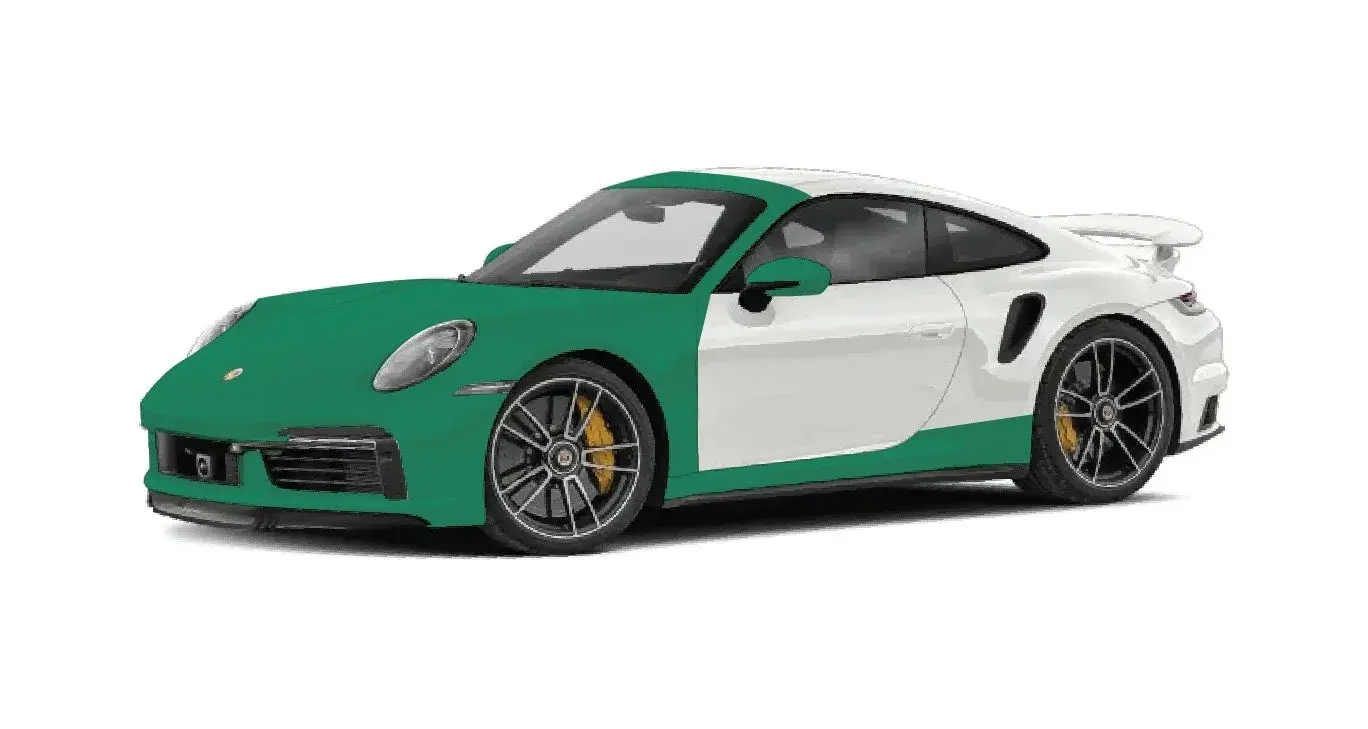
The front end first, then the panels behind the front wheels and the forward-facing edges above the windshield. Each step up the shop’s LLumar Platinum packages adds a band of the car:
| Area | First package that covers it in full | From |
|---|---|---|
| Front bumper, headlights, side mirrors | Partial Front | $850 |
| Hood and front fenders, edge to edge | Full Front | $1,550 |
| Both A-pillars, a strip of roof above the windshield, the rockers | Track Package | $1,900 |
| Doors, rear quarters, the rest of the roof, rear bumper, trunk or engine lid | Full Vehicle | $4,000 |
What the extra $350 buys
The gap between Full Front and the Track Package at starting prices is $350, and it covers the three areas a front package leaves bare. The shop pitches the package at track days and gravel roads for that reason; the panel-by-panel detail and where the film edges fall are on the Track Package page.
When the whole car makes sense
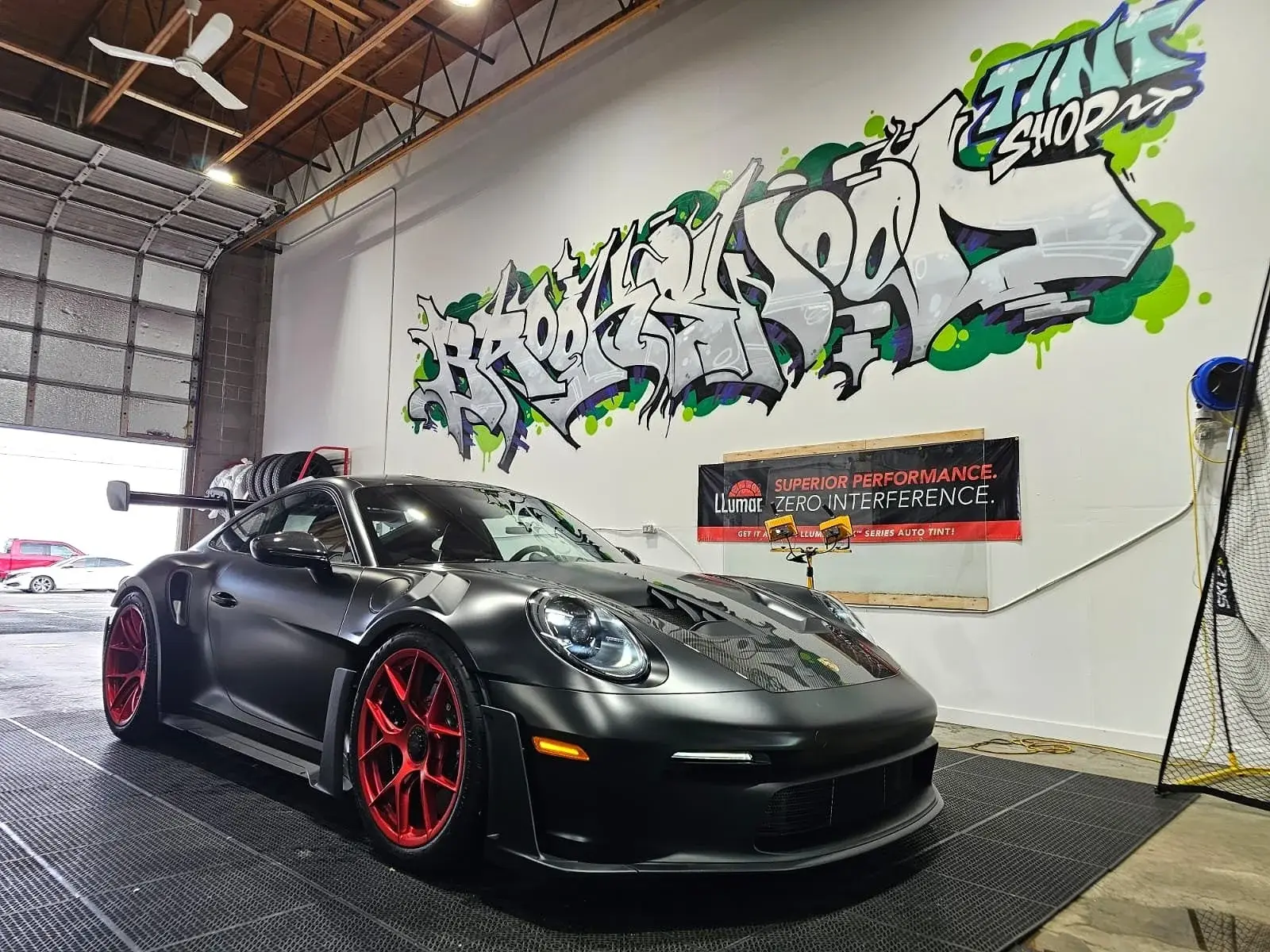
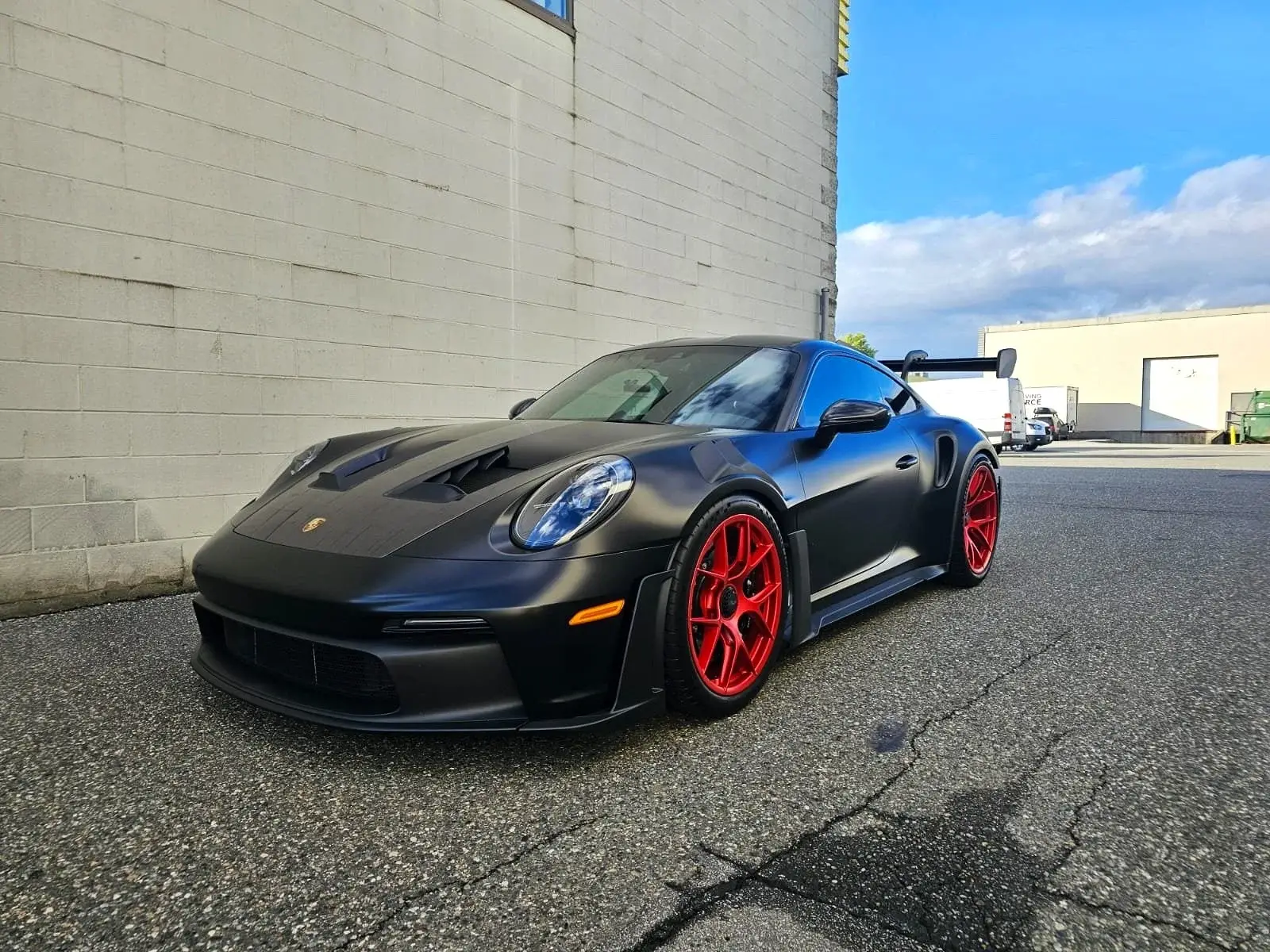
Full Vehicle adds the doors, rear quarters, the rest of the roof and the rear end, at $2,450 more than Full Front and $2,100 more than the Track Package at starting prices. Full front vs full body PPF weighs that jump; the satin GT3 RS pictured on this page is one car that went all the way to full-body film. For supercars with vents, wings and sharp bodywork, PPF on exotic cars covers the extra detail.
Platinum, Platinum Extra or Valor: which film suits track use?
Platinum is the film every package is priced in. Platinum Extra is the one LLumar names for track racing, and Valor is its 12-year option; both are ask-at-booking choices at Brookswood Tint, not standard package films.
| LLumar film | What LLumar says about it | Warranty | At the shop |
|---|---|---|---|
| Platinum Gloss | Self-healing top coat (engine or sun heat) and HydroGard water repellency, aimed at rocks, salt and sand | 10-year limited | Standard in every package |
| Platinum Matte | The same protection with a flat finish that can “transform glossy paint” | 10-year limited | The matte option in any package |
| Platinum Extra | Described as “thicker than traditional PPF”, for “track racing, gravel roads, or harsh weather”, with HydroGard against “dirt, oil, tar, and bugs” | 10-year limited | Ask when you request a quote |
| Valor | Self-healing, with a Tetrashield easy-wash surface; LLumar lists rocks, road debris, winter salt and sand | 12-year limited | Ask when you request a quote |
Sources: LLumar’s own pages for Platinum Gloss, Platinum Matte, Platinum Extra and Valor. None of the four has a published thickness, so there’s no figure to compare; how thick is PPF covers that question, and the film family is described on LLumar Platinum PPF and LLumar Valor PPF.
What self-healing can and can’t do
Per LLumar’s FAQ, the majority of surface scratches close up with heat from sunshine, warm water or a warm engine panel. A stone that cuts through the film is different damage, and no top coat heals a cut. What does self-healing PPF mean explains the line between the two.
Gloss or matte film
Matte film turns gloss paint satin, so a car with matte film on the nose and bare gloss paint behind it will show where the film ends. Decide the finish with the coverage in mind; stealth PPF vs gloss PPF compares them.
How far ahead of a track day should you book PPF?
Allow at least two weeks for a front or Track Package install, and longer if the paint needs correction or has recent bodywork. Count back from the event: prep, then the install, then a week before the first wash.
| Step | Typical time | Note |
|---|---|---|
| Paint correction, if the paint needs it | About a day for an enhancement polish; 1 to 2 days for a two-stage correction | Paint thickness is measured first |
| Partial Front install | Usually 1 day | Paint decontaminated first |
| Full Front or Track Package install | 1 to 2 days | Cut from software templates |
| Full Vehicle install | 3 to 5 days | |
| Before the first wash | A week, the shop’s advice; LLumar’s FAQ says three days | Plan the event after this |
| Freshly painted panels | About 30 days before film, LLumar’s common outgassing wait | Repaired paint sits outside LLumar’s warranty |
Film locks in the paint’s current state, swirls and all, so correction happens first; paint correction explains the stages. If you want to know how the install day itself runs, how long does PPF installation take walks through it.
What does tech inspection check, and where does film fit in?
Tech inspection is about safety: brakes, tires, fluids, loose items and your helmet. Film doesn’t come into it, but a few prep items touch the glass and body, and a film check belongs on the same list.
What the organisers ask for
From SCCBC’s driver training requirements:
- The car must be in “sound mechanical condition with a fully muffled exhaust”.
- “Loose articles must be removed.”
- A Snell SA2015 or newer helmet, shown at tech.
- A passenger seat and at least three-point belts on both front seats; no trucks or minivans; open cars need a CACC-approved roll bar.
From Area 27’s vehicle preparation requirements:
- Front and rear pads with at least 75% of their friction material, and fresh DOT 4 fluid with a wet boiling point of at least 155 °C.
- Floor mats and loose items out of the cabin, trunk and storage bins.
- Anything suction-cup mounted taken off the windshield, because such items “will come loose with high cornering forces”.
- No part of the body touching the tires under extreme loading, and at least 94 octane fuel.
Add your own film checks
- Edges. Walk round the car and look at every film edge, especially the bumper, the hood’s front edge and the rockers. Have a lifted edge fixed before the event, not after it.
- Numbers. If the event needs car numbers, agree with the shop where they’ll go on filmed panels.
- Headlights. Every package already films them. Skip smoked or yellow lamp film for looks: Section 6, item 1.0(a) of the 2025 Vehicle Inspection Manual rejects lenses “covered in any manner”, so tinted lamp film can fail and even clear film may be questioned. Are tinted headlights legal in BC has the detail.
- Windshield. There’s no exterior windshield protection film at this shop, so the glass goes to the track as it is.
What should you check after a session and after the event?
Look over the front and the sills before you drive home, wash the car properly within a few days, and have any cut or lifted film looked at before the next event. Light marks usually heal; cuts don’t.
- In the paddock. If you put wheels off, Area 27 inspects the car for damage; add your own look along the rockers and the lower bumper.
- Washing. LLumar prefers a hand wash with soap, water and a soft, clean cloth over any machine. Keep the pressure wand and the automatic wash away from the film; LLumar says both can lift edges, and edge lifting from them falls outside its warranty.
- Tar, rubber and bugs. Platinum Extra’s HydroGard is pitched against dirt, oil, tar and bugs. Ask the shop which removers are safe on film before you reach for a solvent.
- Fine scratches. Park in the sun or rinse with warm water, and most surface marks fade as the top coat heals.
- Cuts and tears. These don’t heal, and impact damage isn’t among the defects in the shop’s published warranty list. Can damaged PPF be patched explains the options.
The full washing routine for filmed cars is in the PPF aftercare guide.
What do LLumar’s warranty terms mean for a track car?
The 10-year Platinum warranty covers the film failing on its own, not damage the track does to it. Yellowing, cracking, bubbling and peeling are the defects named in the shop’s published terms, and LLumar’s product pages carry the line “certain restrictions apply; see dealer for warranty details.”
Three points in LLumar’s PPF FAQ matter more on a track car than on a commuter:
| Situation | LLumar’s position |
|---|---|
| Film over carbon fibre parts | Carbon “is not considered OEM (original equipment manufacturer) paint, making it ineligible for warranty coverage” |
| Film over aftermarket or repaired paint | “Issues with aftermarket and repaired paint are not covered by our warranty” |
| Lifting at edges after pressure or automatic washes | Discouraged, and not covered by the limited warranty |
If your splitter, canards, side skirts or wing are carbon fibre, decide with the shop whether to film them knowing the warranty won’t follow. Insurance sits apart from all this; we found no ICBC page that deals with paint protection film, so the invoice is your record and ICBC is who to ask.
Booking track prep at Brookswood Tint
Tell the shop the year, make and model, your event date, gloss or matte, and any repainted or carbon fibre panels, through the PPF quote request or by calling or texting 604 534 6433. Photos of existing chips help the shop judge whether correction comes first.
The Track Package starts at $1,900 and keeps the car for one to two days; Full Front starts at $1,550 over the same time, and Full Vehicle at $4,000 over three to five days. Book at least two weeks out so the wash wait has passed before you drive to the circuit. The bay sits at 20560 Langley Bypass, Unit 312, and works 9:00 to 17:00 from Monday through Saturday; the track day paint protection page shows how the shop sets cars up for lapping.