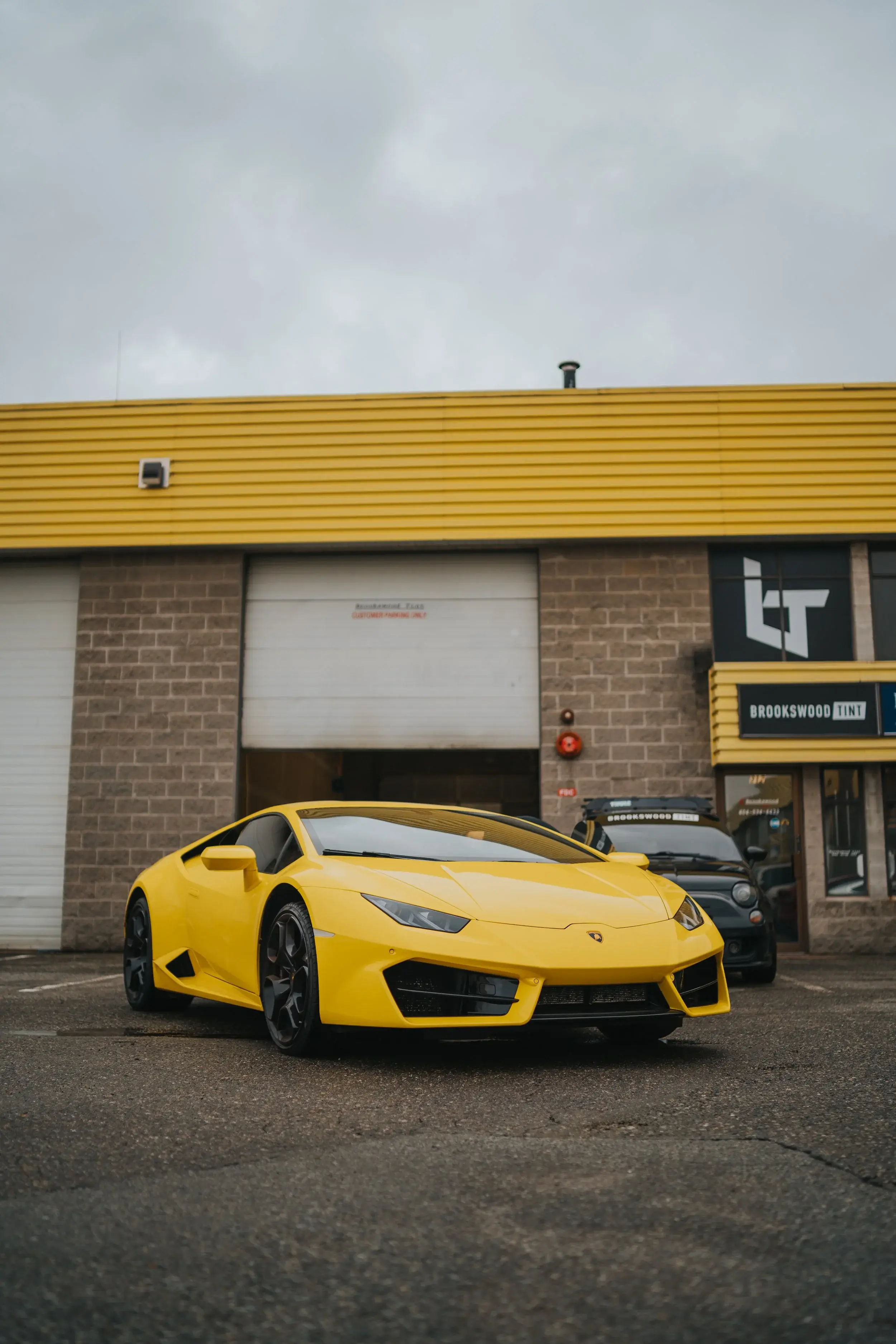
What does protecting an exotic car involve?
Up to five separate jobs, each aimed at a different risk. Paint correction cleans up the surface, paint protection film takes the impacts, a ceramic coating makes washing easier, window film handles heat and UV on the legal glass, and the lamps need a decision of their own. You choose the layers the car and its use call for; none of them has to be bought as a set.
| Layer | What it deals with | What Brookswood Tint uses | Time in the shop |
|---|---|---|---|
| Paint correction | Swirls and marks that film or a coating would otherwise seal in | Enhancement polish, two-stage correction or multi-stage restoration, after the paint thickness is measured | About a day, 1–2 days, or 3+ days |
| Paint protection film | Stone chips and light surface scratches, which the top coat heals with heat | LLumar Platinum in gloss or matte | Partial Front in about a day; Full Vehicle 3–5 days |
| Ceramic coating | Chemicals, light marring and wash grime; not impacts | Graphene-ceramic in one, two or four layers | 1–3 days, then kept dry for 24 hours |
| Window film | Solar heat and UV through glass behind the driver | LLumar ATC, IRX or AIR | Most cars the same day |
| Lamp film | The look of the lights, plus a layer over the lens | STEK in 30% or 50% smoke, clear or yellow | 2–3 hours a pair |
Where the jobs overlap, the sequence doesn’t change: correct the paint, fit the film, then coat film and paint together. Window film sits on the inner surface of the glass and never meets the paint, so it slots into the same stay. The reasoning behind that sequence is on the order for PPF, ceramic and tint.
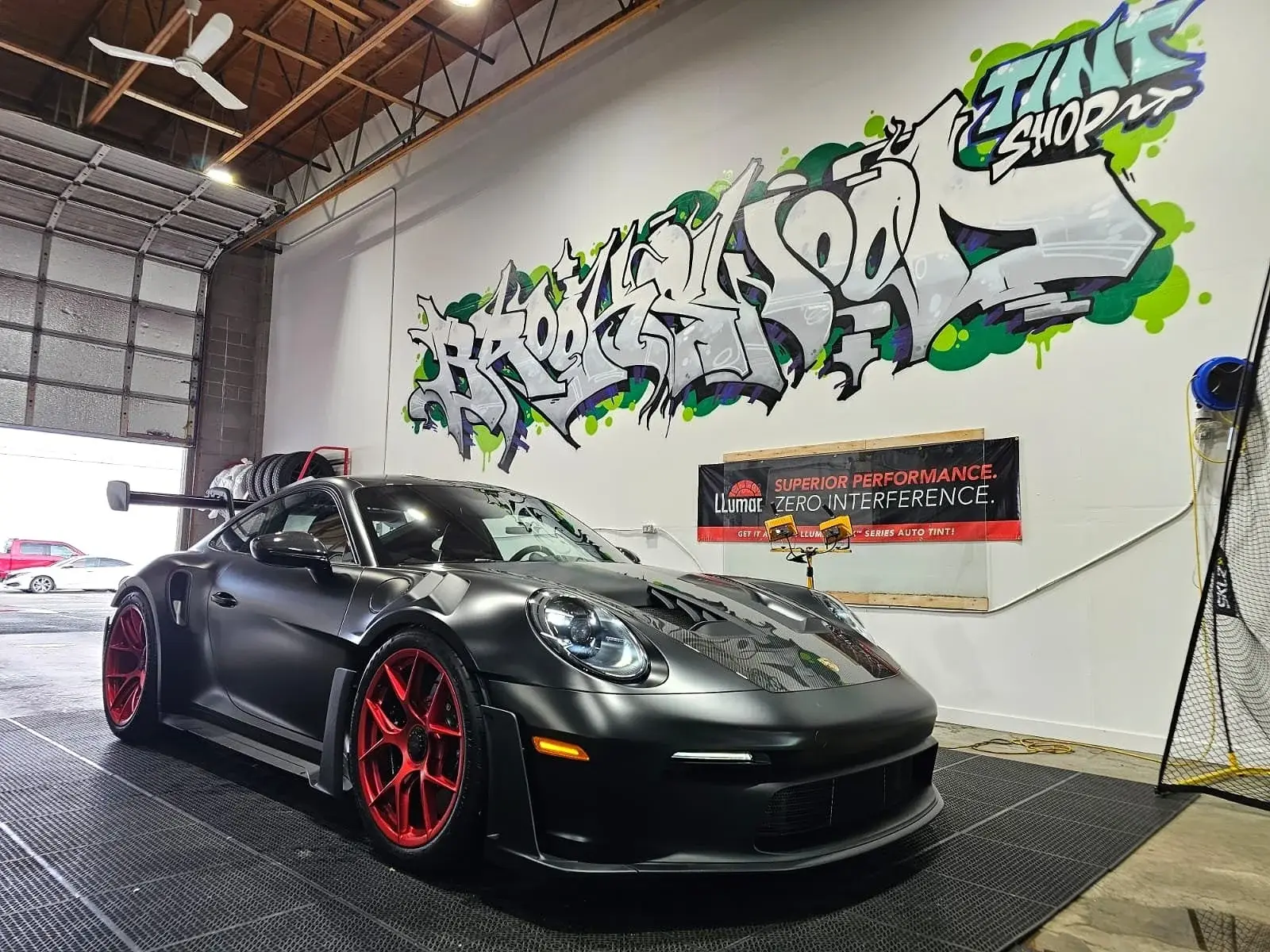
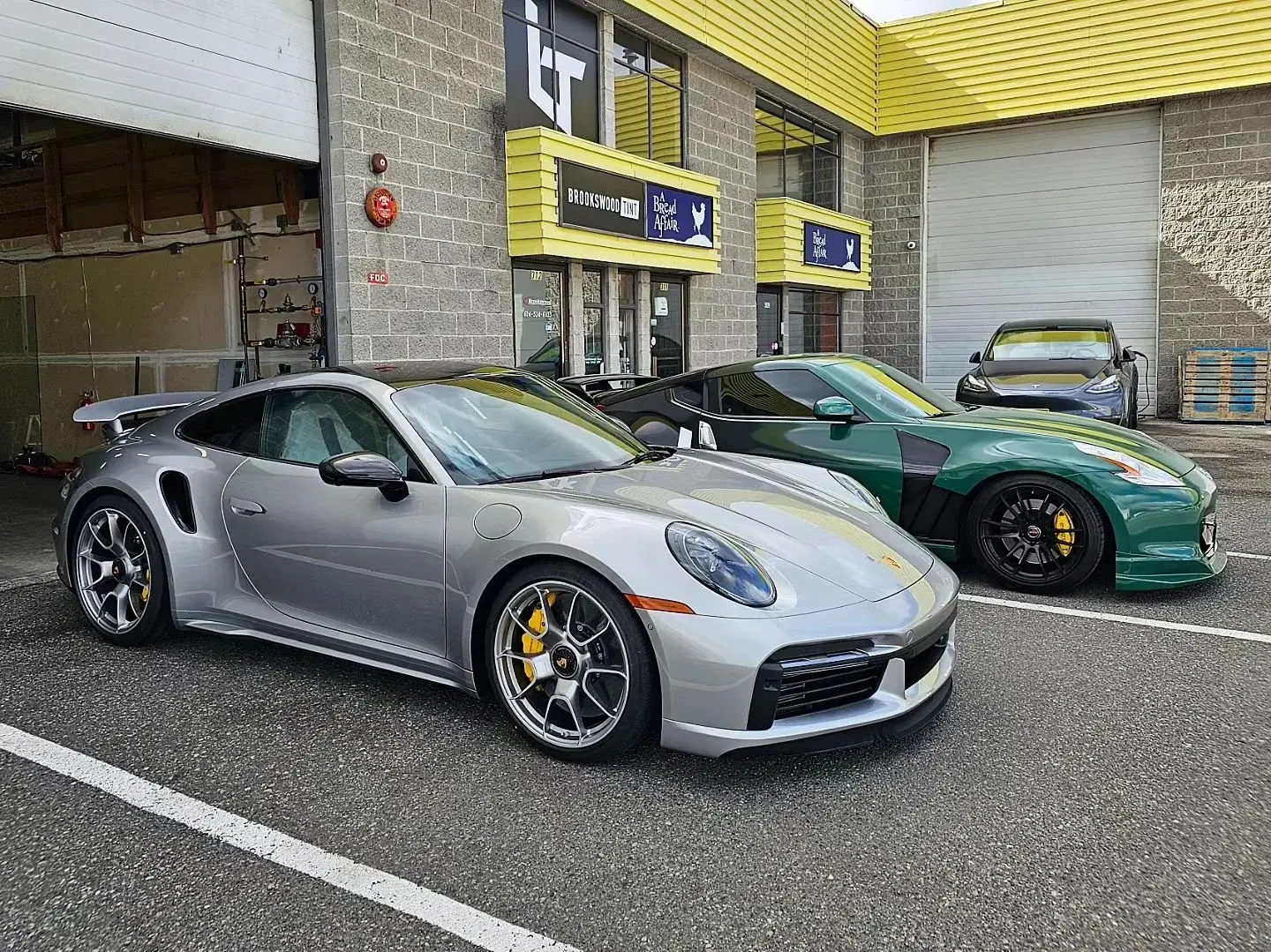
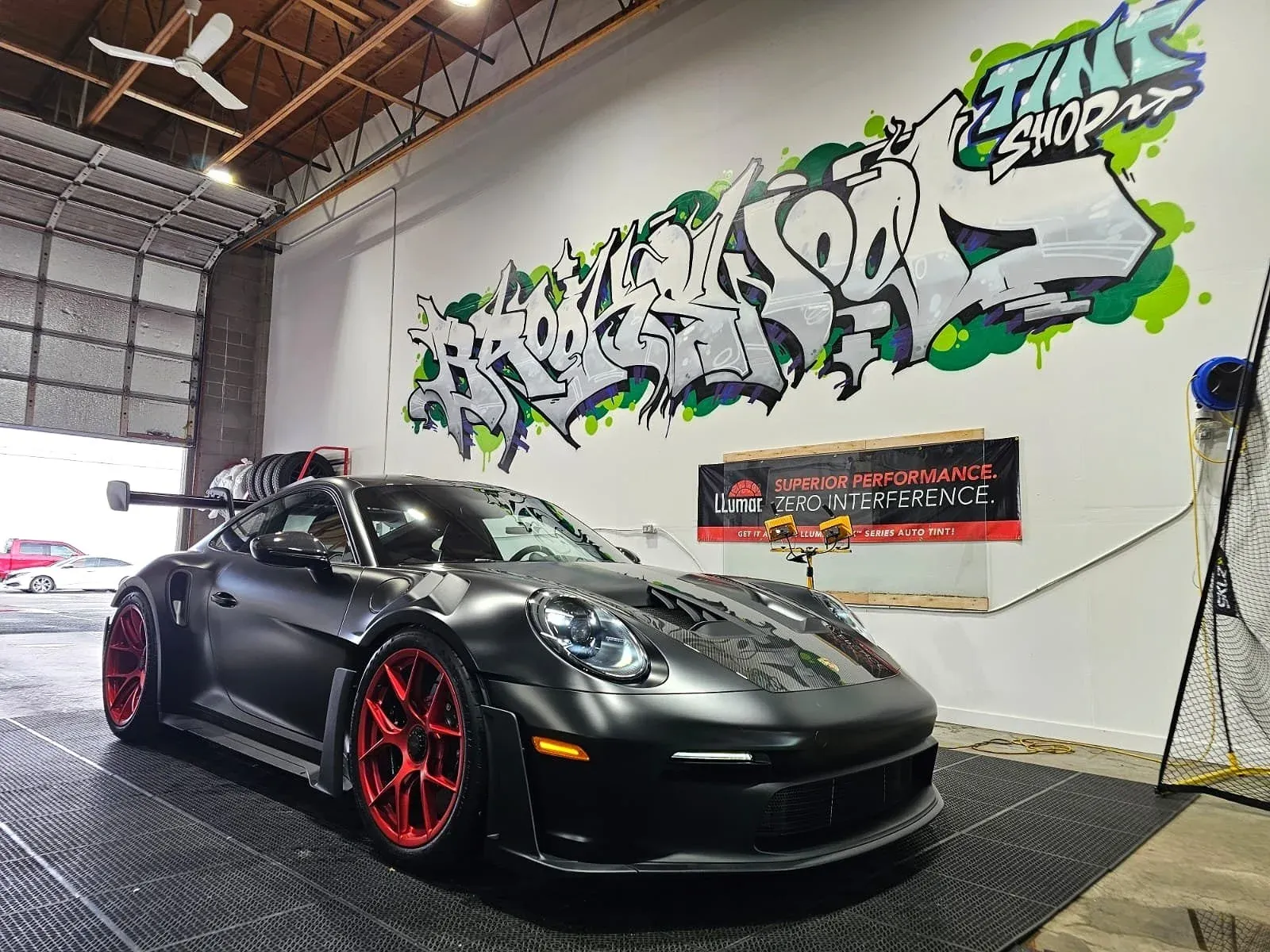
Exotics are priced from the same package figures as any other car and then quoted per vehicle, because size, vents and sculpted panels change the work. Package-by-package prices, and the cars the shop has photographed in its bay, are on exotic and supercar PPF.
Why is factory matte or satin paint harder to look after?
Because it can’t be corrected the way gloss can. A scratch or a shiny patch in a matte factory finish is, by the carmakers’ own account, there to stay, so protection has to go on before the damage rather than after it.
Two manufacturers put this in writing to their dealers. Chrysler’s 2014 bulletin for the matte-finish SRT Viper, number 23-002-14, explains that a matte finish uses a coating made to diffuse light instead of reflecting it, and that damage to it “cannot be polished or buffed out. Once an area is damaged or becomes shiny, the ‘flat’ appearance cannot be restored.” Maserati’s 2022 dealer bulletin on matte paint, MAS002982, is shorter: “Never polish and never use polishing agents anywhere on a vehicle with matte finish paint.”
What that means for film
On gloss paint, a polisher is the safety net. On matte paint there isn’t one, which shifts the whole job to prevention. Matte paint protection film keeps a flat finish flat: LLumar’s Platinum Matte is sold both for paint that is already flat and for giving gloss paint a satin look, with the same 10-year limited warranty as the gloss version. The film then takes the wear the paint can’t recover from, and its self-healing top coat closes light scratches with heat. How matte film compares with the gloss version is set out in stealth PPF vs gloss PPF, and the service itself on matte PPF.
The spots matte owners should watch
Chrysler’s bulletin lists the places a matte finish changes first:
- Door handles, door edges, the hood and the liftgate, which hands touch often enough to polish them shiny over time.
- The area around the fuel door, because gasoline “will degrade the top coat of the matte finish”, leaving shiny marks in the shape of the drip.
- Under the mirrors and below the door openings, where water drip lines that keep drying in place can change the surface texture for good.
When you ask for a quote on a matte car, name these areas and ask which of them the film can reach on your model. PPF on matte paint covers what to expect from the install.
Which parts of an exotic take the most damage?
The nose takes the stones, the sills and lower rear take what the tires throw, and on matte paint the places hands touch wear first. Brookswood Tint’s four PPF packages step outward in roughly that order.
Stones come from the road ahead. TranBC keeps the grit spread on main highways to 9.5 mm or smaller, works out that a stone hits with nearly twice the energy at 110 km/h as at 80, and names the outcome plainly: “windshield chips and paint dings”. The lower sides are a different problem. The same Chrysler bulletin suggests protective Mylar coatings, sold by Mopar, on the Viper’s sills and rear fascia against “tire blast damage”: a carmaker naming the lower sides and the back of the car as places that need covering.
| Area | What reaches it | Smallest package that covers it | From |
|---|---|---|---|
| Front bumper, headlights, side mirrors, leading edge of the hood and fenders | Stones thrown by traffic ahead | Partial Front | $850 |
| Hood and front fenders, edge to edge | The same stones, landing further back | Full Front | $1,550 |
| A-pillars, part of the roof, rocker panels | Whatever gets past the front end, plus what the front tires throw | Track Package | $1,900 |
| Doors, rear quarters, rear bumper, the rest of the roof | Tire blast at the back, hands, everyday contact | Full Vehicle | $4,000 |
Each figure is a floor, not a quote. A bigger car, more intricate panels or paint that needs work all push the number up. Film is tucked around panel edges where the shape permits; where a bumper forces a relief cut, you’re shown its position before work begins. Where the line between front and full coverage falls for your car is laid out in the full front and full body comparison, and the whole-car option on full-body PPF. A car that also does track days should start from the Track Package.
Which LLumar paint protection film suits an exotic?
For most exotics, the film the shop installs: LLumar Platinum, in gloss or matte, with LLumar’s 10-year limited warranty behind it. If the car sees gravel or a race track, ask about Platinum Extra by name.
LLumar’s own pages describe the line this way:
| LLumar film | Warranty term (LLumar) | What LLumar says it’s for |
|---|---|---|
| Platinum Gloss | 10 years | Self-healing film with HydroGard water repellency |
| Platinum Matte | 10 years | A flat finish, over flat paint or over gloss |
| Platinum Extra | 10 years | Its thickest PPF, aimed at gravel, track days and bad weather |
| Valor | 12 years | Self-healing film with “a ceramic-style finish in a single product”, for easier washing |
| Gloss & Matte | 5 years | LLumar’s entry-level film |
LLumar publishes no thickness figures for any of them, so compare films by warranty term and stated purpose rather than by a number a salesperson quotes. Platinum is what Brookswood Tint fits as standard; the family is explained on LLumar Platinum PPF, and Valor has its own page at LLumar Valor PPF.
LLumar’s own warranty wording is brief: a 10-year limited term, with the fine print referred to the dealer. Brookswood Tint adds its own published list: the film is covered if it yellows, cracks, bubbles or peels.
What belongs on an exotic’s glass and lights?
On the glass: any LLumar shade from the rear doors back, rear window included, with ceramic film if heat is the goal. On the lamps: think twice, because film over a lens can fail a BC inspection.
Glass behind the driver
Ceramic film turns away far more of the sun’s energy than dyed film at a similar shade. LLumar’s spec sheet, with every figure taken on 6 mm clear glass, puts total solar energy rejection (TSER) at 50 to 62% across the IRX shades against 28 to 44% for dyed ATC; near-clear AIR 80 still manages 43% while passing 77% of visible light. Every one of them is rated above 99% UV. The shop’s photo library includes a 991.2 911 GT3 whose glass combines LLumar AIR and IRX and a 911 Turbo S in LLumar CTX 15%; CTX is no longer on the menu, and IRX is the ceramic line the shop sells now.
The front windows and windshield
Under MVAR s. 7.05(8), the two door windows level with the driver and everything forward of them stay bare, and the windshield may carry film only in a band no deeper than 75 mm from its top edge. Clear AIR gets no exception. The typical tint ticket, says Mission RCMP, is $109. Officers have a second tool, the Notice & Order, which orders the film removed and the car through a full inspection, and a $598 fine follows if that inspection hasn’t happened within 30 days. If an owner asks for front-door or windshield film, Brookswood Tint will fit it, but the film still breaks BC’s road rules, and the owner hears about the ticket, the order and the inspection before deciding. Front window tint in BC has the detail.
Lamps
Brookswood Tint’s lamp film is STEK, offered as 30% or 50% smoke, clear or yellow. The lamp section of the 2025 Vehicle Inspection Manual rejects, under item 1.0(a), a lens that cuts the light passing through or one that “is covered in any manner”. A tinted or yellow lens film can therefore fail on any lamp, front or rear, and an inspector may query even a clear one, the clear PPF over the headlights included. Read are smoked taillights legal in BC before choosing headlight and taillight film.
What changes when an exotic comes from outside BC?
Expect a provincial inspection before the car can be plated, with front-door film and covered lamps both on its fail list. Plan the film work around it: off before the inspection, legal film after.
A car last registered outside BC, with a net weight of 3,500 kg or less, must pass inspection at a facility the province designates; only then does ICBC register it, and one bought in the US goes through the Canada Border Services Agency before that. Cars last registered in Alberta, Saskatchewan or Manitoba can be exempt if they are recent enough or passed that province’s inspection within 90 days, but an exempt car’s front film is still illegal once it’s driven here.
| Inspection item (2025 manual) | What fails |
|---|---|
| 13d | Aftermarket film, material or coating on side glass forward of the driver’s seatback |
| 12e | Windshield film that extends past the top 75 mm |
| 12e, 13d, 14c | Any tint that is reflective type |
| Section 6, 1.0(a) | Lamps whose lenses are dimmed by film or otherwise covered |
A sensible order for an import: have any front film and lamp film taken off, pass the inspection, register the car, then book PPF, coating and legal glass film. Brookswood Tint takes old film off rear glass with steam, not blades, and will remove just the front two windows when that’s all an inspection needs; see tint removal for an out-of-province inspection. Every glass and lamp item the inspector checks is listed in the inspection checklist for imported cars.
How should an exotic be washed and stored between drives?
Gently and by hand. Film and matte paint both suffer from the same things: brushes, high pressure close up, and products made to add gloss.
Paint protection film
Let new film sit for seven days before it’s washed. That’s the shop’s rule; LLumar’s FAQ allows three days, so the week is the careful choice. From then on, hand washing or a touchless wash is fine, brush washes are out, and a pressure-washer nozzle should never be aimed at a film edge. More on that routine is on washing a car with PPF and in the PPF aftercare guide.
Factory matte paint
Chrysler’s Viper bulletin rules out commercial car washes and their shine products, and any wax, detail spray or other product made for gloss paint. When a pressure washer is used to lift heavy dirt, it says to stay at or below 1,200 psi with a fan tip of 45 degrees or wider, held at least 12 inches (about 30 cm) from the paint. Maserati’s bulletin adds three points: wash by hand only, not in direct sunlight, and with demineralized water to avoid lime-scale halos.
Winter roads and storage
If the car is driven in winter, it meets what BC uses on the roads: TranBC lists salt and brine among the materials its contractors use, alongside “anti-icing agents and abrasives”, and brine goes down on the City of Langley’s priority roads. A ceramic coating over film and paint makes that grime easier to rinse off, and the shop’s wheel coating is aimed at brake dust. Whether film itself stands up to salt is covered on PPF and road salt.
Planning the visit, keeping records and booking
Allow anywhere from one day to about ten, depending on how many layers the car is getting, and keep the paperwork afterwards. The shop’s published timings add up like this:
| Visit | Typical days in the shop |
|---|---|
| Partial Front film on its own | Usually one day |
| Whole front or Track coverage, then a coating | About 2–5 days |
| Two-stage correction, Full Vehicle PPF and coating | About 5–10 days |
| Window film added to any of these | Usually fits inside the same stay |
Records worth keeping
Ask for an invoice that names the film line and finish (for example, LLumar Platinum Matte), lists every panel covered, and dates the install. LLumar routes warranty questions through the dealer, so that invoice is what a claim starts from. If you plan to sell, ask the shop in writing whether the film warranty passes to the next owner; no one should assume it does. For insurance, ICBC publishes nothing on paint protection film, so keep the invoice and ask ICBC or your insurer directly.
Booking
Use the PPF quote request to tell the shop the car, its year and its paint (gloss, satin or matte), which layers you have in mind, and whether there are chips, marks or import papers in the picture. To talk it over first, phone or text 604 534 6433. Drop-offs go to Unit 312, 20560 Langley Bypass, any day but Sunday, between 9:00 and 17:00.